
- Research
Sustainable Lifestyle Receptivity Survey 2023
Sustainable Lifestyle Report 2023
Dentsu Institute and Dentsu Inc. have jointly conducted the third edition of the Sustainable Lifestyle Receptivity Survey. The 2023 survey, which follows up on the previous iteration undertaken in 2021, polled respondents in six countries: Japan and China in East Asia, France and Germany in Western Europe, and Indonesia and Thailand in Southeast Asia. In each country, the survey targeted 1,000 individuals between 18 and 69 years old, culminating in a total of 6,000 respondents.
The results of the 2021 survey, influenced by the COVID-19 pandemic, showed people’s interest in healthcare systems and public health concerns. At the same time, there was also a sharper focus on social issues related to human rights exemplified by movements like Black Lives Matter, which emerged in the United States. Subsequent global developments, including the Russia-Ukraine conflict, rampant global inflation, and the effects of climate change such as water shortages and extreme weather conditions, have escalated demands for greater transparency in corporate Sustainability practices. As a reflection of these shifts, the 2023 survey reveals a perceptible change in the outlook towards Sustainability, which is no longer seen merely as an initiative specially undertaken by individuals or organizations with a high level of awareness, but is being increasingly recognized as a universal initiative with direct relevance to everyday life.
Drawing on the survey results, this article focuses on compiling and comparing international perspectives on attitudes and actions related to Sustainability.
* For more details on the report, please visit:
Sustainable Lifestyle Receptivity Survey 2023 (English version)
Survey Results
1. Frequency of thinking about Sustainability
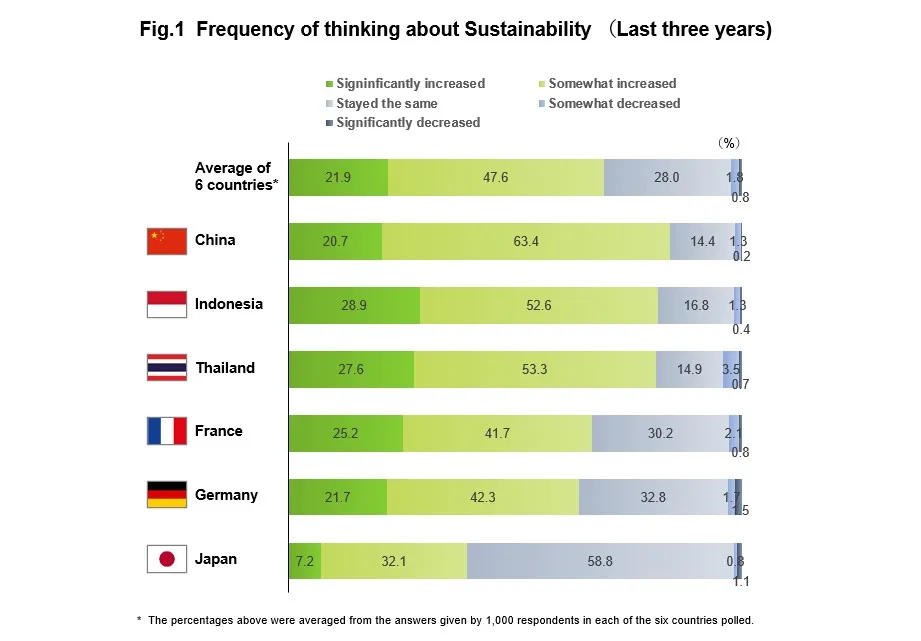
Respondents who indicated that their frequency of thinking about Sustainability had increased in the last three years (by answering “significantly increased” or “somewhat increased”) exceeded 80% in China (84.1%), Indonesia (81.5%), and Thailand (80.9%), followed by France (66.9%) and Germany (64.0%), where over 60% of respondents indicated an increase. A noticeable difference is seen in Japan, where only 39.3% of respondents reported an increase in thinking about Sustainability. In Japan, a majority (58.8%) answered that their frequency of thinking about Sustainability had “stayed the same.” (Figure 1)
2. For many, Sustainability is synonymous with reducing waste
What do people think of when they hear the word “Sustainability”?
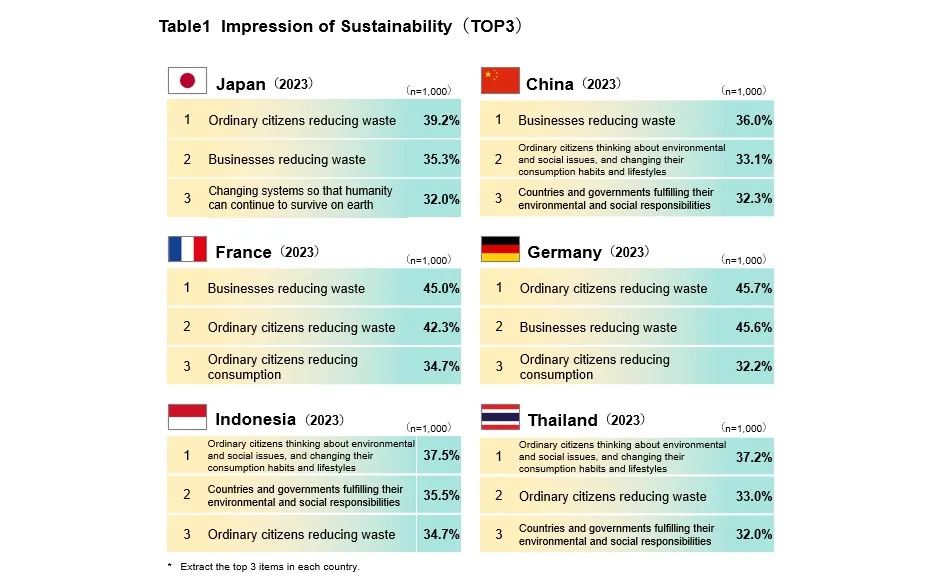
When asked about their associations with Sustainability, a large proportion of respondents in all six countries linked it to waste-reduction activities as either “ordinary citizens reducing waste” or “businesses reducing waste.” The survey presented a wide range of other sustainability-related options. For instance, options included “countries and governments maintaining peace,” “countries and governments creating equal opportunities in education,” “businesses increasing sustainable income and providing balance to employment and the economy,” “businesses fulfilling their environmental and social responsibilities,” “ordinary citizens living compassionately and close to nature,” and “ordinary citizens thinking about environmental and social issues and changing their consumption habits and lifestyles.” Among these diverse options, an association with waste-reduction activities was consistently among the top responses in every country. This highlights the strong connection between waste reduction and people’s ideas about Sustainability. (Table 1)
3. The relationship between environmentally conscious lifestyle practices and well-established systems
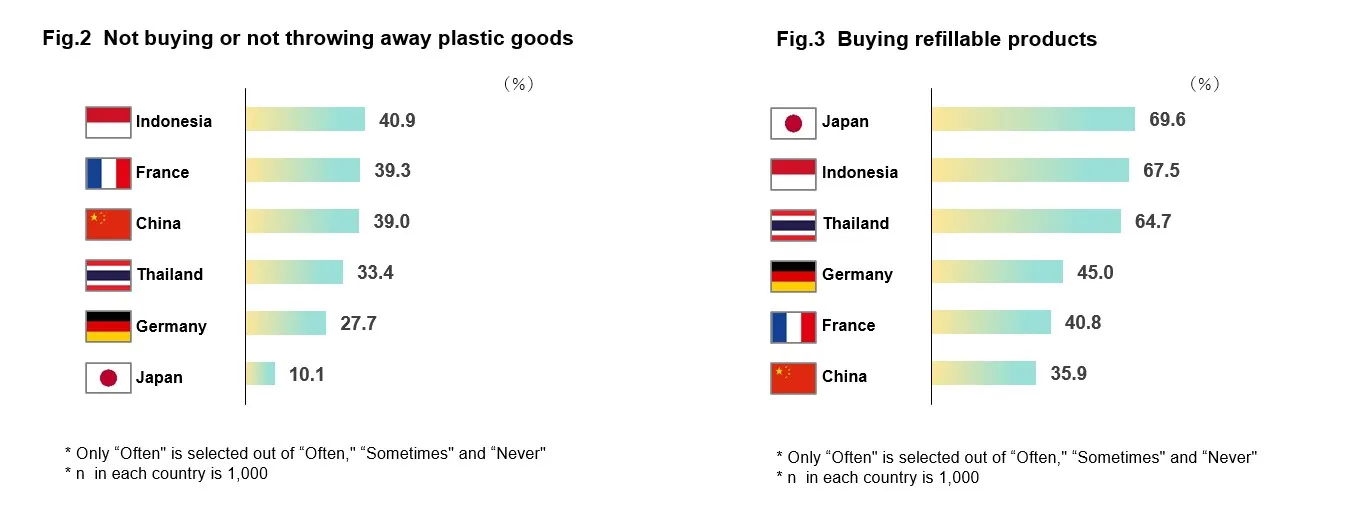
The survey inquired about the extent to which various environmentally conscious lifestyle practices are integrated into respondents’ daily lives. The graph below arranges the six countries in descending order of the percentage of respondents who answered that they “often” engage in the listed practices, among the options “often,” “sometimes,” and “never.”
■ Shopping habits
The practice of “not buying or throwing away plastic goods” is most prevalent in Indonesia (40.9%), France (39.3%), and China (39.0%). This reflects a shift in several countries towards reducing plastic products, spurred by a heightened awareness of marine plastic waste. Indonesia has a history of handling the recycling of plastic products from foreign countries, but now strictly prohibits the import of plastic waste.*1 Moreover, action plans have been announced to reduce plastic waste from rivers and beaches into the ocean.*2 Meanwhile, France has implemented regulations demonstrating a commitment to reducing plastic use, including mandating non-plastic alternatives for delivery and takeaway containers. (Figure 2)
In the top-ranked countries for “buying refillable products,” such as Japan (69.6%), Indonesia (67.5%), and Thailand (64.7%), a wide variety of everyday goods are available in refillable forms. This contrasts with Germany, France, and China, where refillable products are less common, resulting in fewer people who would “often” make such purchases. (Figure 3)
■ Waste disposal and recycling practices
Germany (79.2%) and France (77.6%) lead the rankings in the category of “reducing waste by sorting rubbish and recycling,” followed by Japan and China (both at 63.9%), Thailand (60.6%), and Indonesia (54.0%). These results indicate that a majority of people in each country frequently engage in waste separation and recycling, suggesting that sorting and recycling have become established routine practices in these nations. (Figure 4)
In France, which ranks highest (42.6%) in the practice of “taking clothing, toys, packaging, etc. to collection boxes at shops,” specialized collection boxes for clothes, shoes, and bags are installed on local sidewalks and public streets, indicating a well-organized collection system. These collected items are sorted and utilized for recycling, resale, or donation.*3 (Figure 5)

■ Eco-friendly bags and personal water bottles
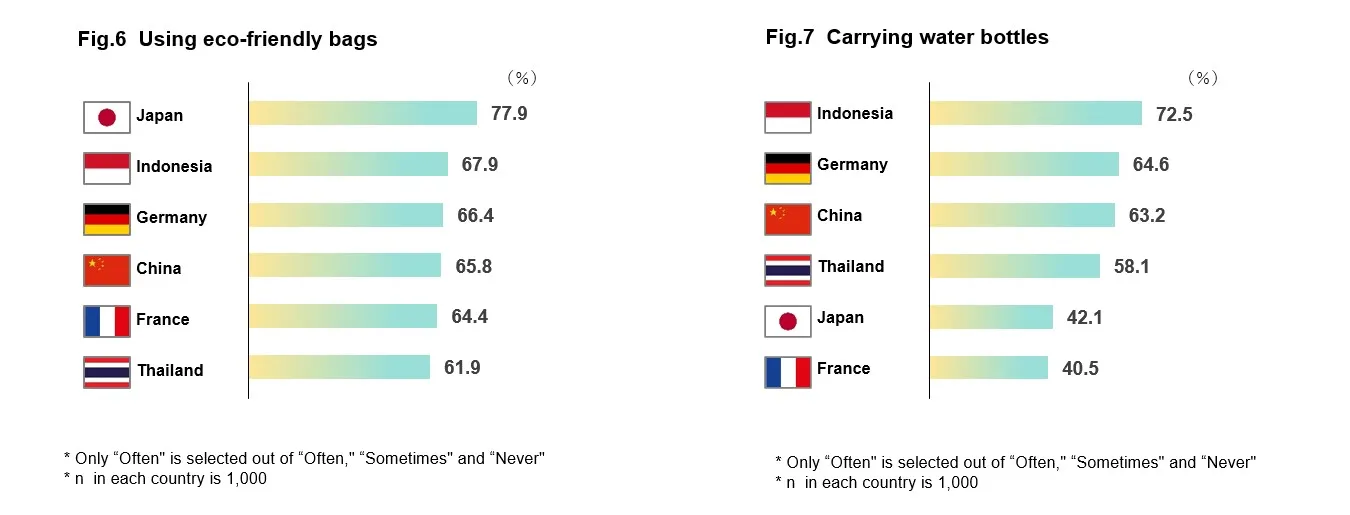
Over 60% of respondents in all six countries reported frequent usage of “eco-friendly bags.” Japan leads with 77.9%, reflecting the widespread adoption of eco-friendly bags three years after the introduction of a charge for plastic shopping bags. (Figure 6)
While not as prevalent as eco-friendly bags, “carrying water bottles” is still a common practice, with over 40% of respondents in all six countries reporting frequent usage. The increasing availability of cafes offering services for personal bottles and apps providing locations of water refill stations in various cities suggests that the practice is becoming ingrained in daily life. (Figure 7)
■ Food choices and their environmental impact
The practice of “bringing home leftovers after visiting a restaurant” varies significantly among countries, with China leading at 66.9% and Japan trailing the pack at 10.4%. This variation reflects diverse backgrounds: some countries have a tradition of taking leftovers home, others have mandated it by law, and some avoid it due to food hygiene concerns. However, given mounting concerns over food waste, it is expected that an increasing number of restaurants worldwide will begin to provide containers for leftovers. In addition, these containers are likely to be made of recyclable or reusable materials, in line with global regulations aimed at reducing plastic use.*4 (Figure 8)
In the category of “eating plant-based meat substitutes,” Indonesia, home to the world’s largest Muslim population, ranks highest at 29.5%. An increasing number of fast-food restaurants and cafes in Indonesia are offering plant-based menu options out of religious considerations. In contrast, in Japan, which ranks lowest at 5.5%, plant-based meat has only limited availability in shops, reflecting its lack of widespread adoption. However, the development of plant-based meat substitutes is advancing around the world. Given the considerations for religion, health, and environmental concerns, these alternatives are expected to gain more traction in the future. (Figure 9)

*1 Indonesia’s prohibition of importing plastic waste was legislated in the late 2000s. However, due to the ambiguous definition of “waste,” the import of plastic waste continued. Following decisions by China, Malaysia, Thailand, and Vietnam to tighten restrictions and implement bans on the import of plastic waste, Indonesia also began to intensify its own regulations from 2019 onwards.
*2 Indonesia’s National Plastic Action Partnership (NPAP), a public-private nonprofit partnership, released “Radically Reducing Plastic Pollution in Indonesia: A Multistakeholder Action Plan” in 2020.
*3 In France, the production of clothes, shoes, and linen amounted to approximately 830,000 tons in 2022. In 2021, around 240,000 tons of used clothes were collected, of which about 190,000 tons were sorted. After sorting, 58% of these clothes were reused, 33% recycled, and 9% repurposed as solid fuel.
*4 For example, EU member states have set 2030 targets for reducing waste from packaging containers. Regulations regarding plastic products are increasingly being adopted around the world, including a mandate for transitioning packaging materials to recyclable options and reusing packaging containers.
Note: Individual percentages in the graph are calculated based on actual respondent numbers and are expressed as rounded figures, so total percentages may not exactly match the sum of individual percentages.
The survey’s margin of error (1,000 samples per country) is ±3.2 at a 95% confidence interval, calculated at the highest error value for a 50% response score. Differences exceeding ±3.2 points between countries are considered statistically significant.
Survey period: July 12 to August 21, 2023
Methodology: Online survey
Regions: 6 countries (Japan, China, France, Germany, Indonesia, Thailand)
Respondents: 18 to 69 years old, 6,000 total (1,000 per country)
Survey agency: Toluna Japan
E-mail: qsociety@dentsusoken.com
Text by Mayumi Nakagawa
